
Hives: A-to-Z Guide from Diagnosis to Treatment to Prevention
What are hives?
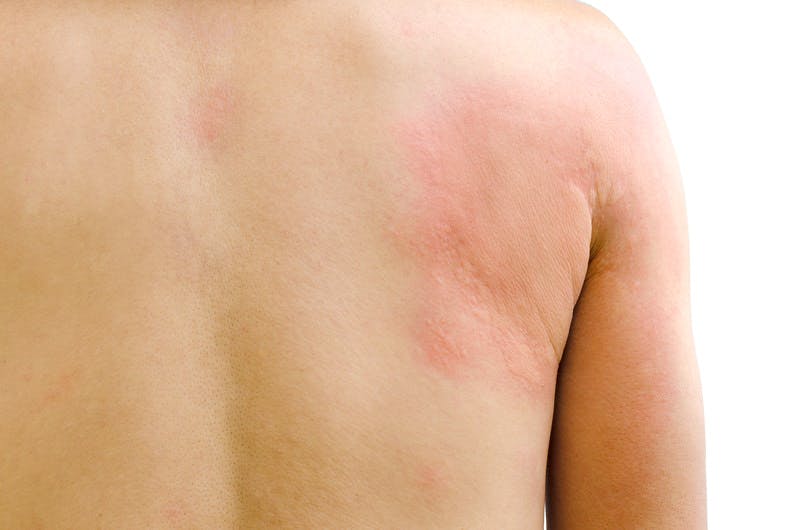
Hives are a sign that the body is experiencing a hypersensitivity reaction. Hives occur when the body’s capillaries and tiny veins get leaky. Fluid escaping from some of these blood vessels becomes trapped in parts of the skin and lining membranes of the body, causing localized swelling.
This leakiness can be caused by classic allergic reactions in which histamine triggers an inflammatory response. It can also be caused by a number of other regulatory systems in the body in response to different types of triggers.
The most common allergic triggers are drugs, especially antibiotics; foods, especially fish, shellfish, nuts, peanuts, eggs, berries, and food additives; infections (which we’ll discuss below); insect bites or stings; inhalants such as animal danders, pollens, and molds; and contact allergens like plant substances, skin creams, cat scratches, moth scales, or animal saliva. In college I had a pet tarantula for a while, and some of my friends got hives from petting her hairy abdomen.
There are also a number of distinct physical causes of hives (known as urticaria in doctor-speak):
- Cold urticaria – the most common of the physical causes. These hives are triggered by exposure to cold water or air. This would be a good excuse to avoid swimming in cold pools (something my kids love for me to do).
- Dermatographia — hives that appear where the skin is firmly stroked. (Named because you can write on someone’s skin by raising welts where your finger traced). This occurs in about 5% of people (and many more if you repeatedly stroke hard enough).
- Pressure urticaria — hives that appear under tightly fitting clothing or jewelry. Unlike dermatographia, which occurs in seconds, this can appear many hours later, obscuring the cause.
- Cholinergic urticaria — hives that occur in response to heat, exercise, or emotional stress. This usually doesn’t begin before adolescence.
- Aquagenic urticaria — hives that are triggered by contact with sweat or with water. In these people, exercise itself is not a trigger, and they can drink water without a problem.
- Solar urticaria — a rare disorder in which sun exposure results in hives. Sunscreen can help!
I mentioned earlier that infections could trigger hives. We know that some parasites can be responsible for hives (including giardia and pinworms, which are common in day care settings). We also know that bacterial infections, most notably Strep, can be the culprit. Viruses of many types can trigger hives as well.
Over 70 percent of the time, no specific cause is found when children have hives. They were hypersensitive to something, but no one discovers what, and the hives go away. Many doctors think that most of these unidentified cases may be from viruses, which would make them the most common cause of hives. This is particularly likely when there is a cluster of cases (although molds, animals, foods, parasites, etc. could also be responsible for clusters).
Who gets hives?
About 20 percent of people will experience hives at some point in their lives. Those who have known allergies or a family history of allergies are more likely to get hives. All other things being equal, girls are more likely to get them than boys.
What are the symptoms?
Wheals or welts come and go on the skin or mucous membranes. These may itch intensely, itch only a little, or not itch at all.
Each typically has a whitish, raised patch of skin surrounded by a reddish halo. The welts may be tiny or large, and may be all over the body or confined to one area.
Are hives contagious?
Hives themselves are not contagious, but the triggers of hives, especially viruses, bacteria, and parasites, may be contagious.
How long do they last?
The individual welts often disappear quickly and are usually gone within 48 hours, although new ones may continue to appear for days or weeks. If new hives keep occurring for six weeks, this is called chronic Urticaria.
How are they diagnosed?
Usually hives can be diagnosed based on the history and physical examination. Sometimes specific allergy testing or testing for infection is needed to look for the underlying cause.
Chronic urticaria is usually not serious, but can be a sign of an underlying disease process. Children with chronic hives should have a thorough physical exam and lab work just to be sure there are no underlying illnesses. They are sometimes referred to an allergist for further workup and care.
How are hives treated?
Hives are usually treated with an antihistamine, such as Benadryl or the prescription Atarax. If drowsiness is a problem, one of the newer, non-sedating antihistamines may be a better choice. Sometimes antihistamines are coupled with a histamine H2 blocker, such as cimetidine, for a more powerful effect.
A variety of stronger treatments are available, but are usually unnecessary. If there are other allergic symptoms, such as wheezing or tightening of the throat, then a shot of epinephrine may be needed.
Hives can be quite uncomfortable. I remember getting hives after being stung by a jellyfish, and I couldn’t sleep without Benadryl for several nights. I discovered that distraction can sometimes help with the itching. This is one situation where videos and music might be a real boon. And don’t forget to add an extra hug or two.
How can hives be prevented?
The best way to prevent another bout of hives is to identify your child’s triggers and avoid them. If you know in advance that your child will be exposed to a trigger, a preventive dose of antihistamine can prevent or minimize the hives.
Related concepts:
Chronic Urticaria, Urticaria, Welts, Wheals
Alan Greene MD


Our goal is to improve children's health by inspiring parents to become knowledgable partners who can work with their children's physicians in new and rich ways.