Pose your questions on Ask, Answer, Learn to Dr. Greene and the DrGreene.com community.
Ask DrGreene
Dr. Greene will be chatting live for one hour on Tuesday February 16th at 10:00 a.m. PT (Noon CT) (1:00 p.m. ET). Click Here to chat with Dr. Greene
Fast Fact
Some children have seizures or convulsions when they have fevers. Febrile seizures occur in 3% to 5% of otherwise healthy children between the ages of 6 months and 5 years. Toddlers are the most commonly affected.
The seizure begins with the sudden sustained contraction of muscles on both sides of a child's body -- usually the muscles of the face, the trunk, the arms and the legs. Often a haunting, involuntary cry or moan emerges from the child, from the force of the muscle contraction.
The child will fall, if standing, and may pass urine. He may vomit. He may bite his tongue. The child will not be breathing, and may begin to turn blue. Finally, the sustained contraction is broken by repeated brief moments of relaxation -- the child's body begins to jerk rhythmically.
Febrile seizures are brought on by the sudden stimulation of many brain cells at once. Experts argue over whether febrile seizures are triggered by the height of the fever or by the rate of rise. I suspect that both play a role.
Most febrile seizures occur well within the first 24 hours of an illness, not necessarily when the fever is highest. Often the seizure is the first sign of a fever, making febrile seizures hard to prevent.
A simple febrile seizure stops by itself within a few seconds to 10 minutes, sometimes followed by a brief period of drowsiness or confusion. Anticonvulsant medicines are generally not needed.
A complex febrile seizure is one that lasts longer than 15 minutes, occurs in an isolated part of the body, or recurs during the same illness.
During the seizure leave your child on the floor, although you may want to slide a blanket under him if the floor is hard. Move him only if he is in a dangerous location. Loosen any tight clothing, especially around the neck. If possible, open or remove clothes from the waist up. If he vomits, or if saliva and mucus build up in the mouth, turn him on his side or stomach.
Don't try to restrain your child, or stop the seizure movements.
Don't try to force anything into his mouth to prevent him from biting his tongue, as this increases the risk of injury.
Focus your attention on bringing the fever down. Inserting rectal acetaminophen (Tylenol) is a great first step -- if you happen to have some.
Don't try to give him anything by mouth.
Apply cool washcloths to the forehead and neck. Sponge the rest of his body with lukewarm (not cold) water. (Cold water or alcohol may make him shiver and make the fever worse).
After the seizure is over and your child is awake, give him the normal dose of ibuprofen (Motrin or Advil) or acetaminophen (Tylenol).
Children should see a doctor as soon as possible after their first febrile seizure. If the seizure ends quickly, drive him to an emergency room when it is over. If the seizure is lasting several minutes, call 911 to have an ambulance bring him to the hospital.
Most febrile seizures are brought on by fevers arising from viral upper respiratory infections, ear infections, or roseola. Meningitis causes less than 0.1% of febrile seizures but should always be considered, especially in children less than one year old or who still look ill when the fever drops.
About one third of the children who have had a febrile seizure will have another one with a subsequent fever (about 2/3 won't). Of those who do, about half will have a third seizure.
Sometimes febrile seizures run in families. If there is a family history, if the first seizure happened before 12 months of age, or if the seizure happened with a fever of <102, a child is more likely to fall in the group that has more than one febrile seizure.
To prevent future febrile seizures, give acetaminophen (Tylenol) and/or ibuprofen (Motrin or Advil) at the first sign of a fever (you may want to keep acetaminophen suppositories on hand). Then sponge your child with lukewarm water. Also give him cool liquids to drink -- both to lower the temperature and to keep him well hydrated.
There is no evidence that febrile seizures cause death, brain damage, epilepsy, mental retardation, a decrease in IQ, or learning difficulties.
A small number of children who have had a febrile seizure do go on to develop epilepsy, but not because of the febrile seizures.
Dr. Greene, do you have any more tips for vacationing with babies and toddlers? I loved your article about how to keep kids on their schedules and how to anticipate their needs, but I have two very young children, and our last trip was still exhausting. We are headed to the beach next week.
Sunny California
When my youngest son, Austin, was just a toddler, we took him on a winter vacation with my extended family. We purchased and packed winter clothes. We scrambled to buy snow chains (that we later found out didn't fit!). We struggled to shove everything into the car. And finally, we were off. Of course we weren't able to get on the road until late, so by the time we arrived, everyone was tired. Some vacation!
The next morning, the whole family played in the snow. We built a snowman, and my father "shared" his hat and scarf with Mr. Snowman for the family pictures. We slid down our very own hill to giggles of delight. It was great fun - until we got soaking wet and cold. So we all bundled up and went for a scenic drive. Of course a scenic drive on winding mountain roads doesn't make every tummy happy. Need I say more?
By the time we got back to our cabin, it was late. Dinner still wasn't ready - not a great thing for over-tired kids. Is this really a vacation???
Our room wasn't heated properly so we all had to sleep in our clothes that night -- all our clothes - except for the ones that were still wet from the snow. And I must say, "sleep" is an exaggeration.
But then morning came. Snowflakes gently floated to earth in one of those rare moments when you wonder if you are inside a snow globe. It was Austin's first snowfall! I'll never forget the look on his face as I held him in my arms and he experienced SNOW. The sparkle in his eyes was a reflection of the wonder all around us, and at that moment, we had a vacation.
We packed up and left a short time later. We tried to beat the storm and the crowds back to the city, but we were too late. What had been a four-hour drive on the way up became a grueling nine-hour return trip. And then came unpacking, and drying everything out, and cleaning the car, and trying to get ready for work the next day.
Vacation?! Yes! But not in the adult sense of the word. Not a time for relaxation and pampering. Not a time to look forward to and back on as a break from work. No, a vacation with kids is a whole different experience. It's a time to share new experiences. It's a time to introduce our children to sights and sounds and tastes that they can't get at home. It's a time to build family memories. It's a time just to be together.
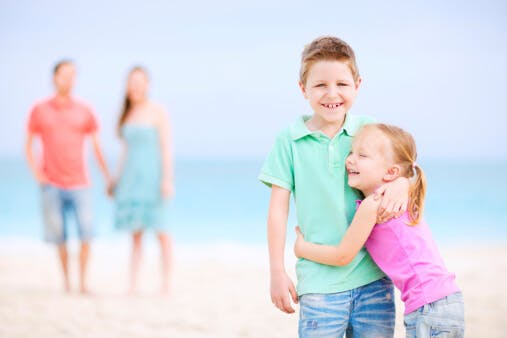
So, tips for surviving family vacations with babies in the mix? Change your own expectations of what a vacation is. Don't get uptight when the schedule doesn't work. Don't worry if everyone isn't happy (after all, it's nearly impossible to make three kids happy all the time no matter what you do!). And when those moments of "vacation" happen - when your children toddle into the surf and touch their toes in the cold water for the first time; when one child pours a bucket of sand over her head and giggles at the feeling of sand in her clothes; when dad pretends to sleep on the beach and the whole family buries him in the sand, and then stands back to exclaim that they have out-smarted dad -- at those moments, remember that you are building a life-time of memories for your children. You are truly on vacation!
Infections can be avoided both by decreasing the exposure to germs and by boosting your child’s immunity. Click here for 6 powerful ways to decrease germ exposure.
So should we be concerned about a little boy who wants to be called a girl...
I walked without crawling when I was a kid and I think my daughter is on the...
I'm sure you will check with the baby's pediatrician, but you can also check...
Does she have any friends or cousins who are potty trained? My daughter...