
Ergonomic Safety
Question
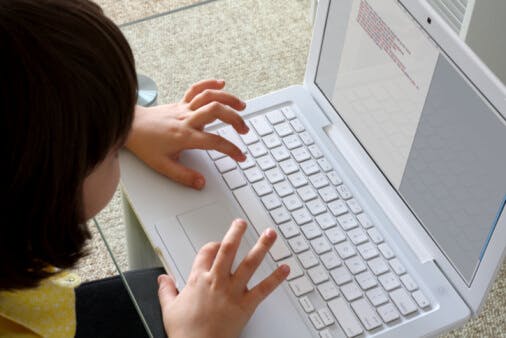
Ergonomic safety has become a big issue in the work place, but not in schools, child care centers and homes where more and more kids are using computers in setups designed for adults twice their size. Do you think there's a potential safety hazard here in cumulative trauma injuries, eye strain, etc.? How might we go about reducing the risk and improving children's computer safety?
Carl Hall - Executive Board Member - West Portal CARE, Inc. - San Francisco, California
Dr. Greene's Answer
When Goldilocks entered the house of the 3 bears, she was quick to recognize when the porridge was “too hot” or the chair was “too big” for someone her size. She had the good fortune to happen upon a chair that was “just right,” and she sat down in it. Most of our children are not so fortunate.
Sadly, they are so used to living in a world designed for adults that they don’t even notice when they sit down at a computer that the angles are all wrong. Hours disappear as they sit with rapt attention to the screen, surfing the web or playing their favorite games. They remain unaware that their awkward, unnatural postures are transmitting the wrong information to their growing bodies.
My back aches. . . I have this pain between my shoulders. . . I’ve had this tingling in my hands the past few days. . . My right hand doesn’t seem as strong as it did. . . My lower neck is bothering me. . .
Complaints such as these have become common from adults who sit for too many hours in front of computers with their bodies in incorrect positions. These common injuries develop gradually over time. Called cumulative trauma disorders (CTDs), or repetitive stress injuries (RSIs), they can be caused by repeated, constant, or excessive stress on muscles, tendons, ligaments, bones, and nerves. Today, RSI is the number one health problem in the work environment, resulting in huge costs from absenteeism, loss of productivity, the explosion of workmen’s compensation claims, litigation, eye problems, chronic pain, loss of sensation, and loss of strength.
To combat RSI, the science of ergonomics has come to the fore. Ergonomics is a term taken from the Greek word “ergon,” meaning work, and “nomos,” meaning law. In other words, ergonomics refers to the natural laws of doing work. It’s the science of designing the tools and the environment to fit the worker. Ergonomics began during World War II in the design of aircraft. Now ergonomics helps in the design of computer workstations.
To prevent injuries, ergonomists first determine the activities and anatomy of those using the computers. To do this, they conduct many tests to find out the typical body size and common physical tendencies of the users, such as muscle movement and vision. They use instruments like anthropometers and sliding calipers to measure many aspects of the human body. They conduct simulations to watch how people use the computers.
Based on this research, ergonomists design computer equipment to fit the needs of the users. Ergonomics has been very successful. As a result adults can work more safely, comfortably, and efficiently.
Children’s flexible bodies are in some ways more forgiving than those of adults. My kids can easily sit on the floor in positions that would give me backaches. For most children, it would take many more hours of cumulative trauma than it would for an adult to cause aches or tingling (this can happen, though — it’s amazing how long a kid can stay glued to a computer game without a break). Of greater concern is the impact that improper positioning might have on growth and development. We know that bones continuously remodel themselves during childhood. This remodeling is directed by the positioning, the stresses, and the use of the bones (as well as the nutrients available). Consistent improper positioning can change the length and shape of long bones. While this hasn’t been proven to come from computer use, I’m not aware that anybody has investigated the possibility.
Fortunately, there is more and more attention being paid to children’s computers and work areas in recent years. After all, computers have become a very large part of a typical school-aged kid’s day! Still, most of the equipment used by kids was developed for adults (with some exceptions, of course), and adaptations need to be made to ensure that a child’s positioning is safe and comfortable. Some adjustments are relatively easy to make, and can make an enormous difference to the child.
Here are some of the basic lessons learned from ergonomics for promoting optimal health. They can be applied to both adults and children.
- Adjust the chair so you can sit with your feet flat on the floor and your thighs parallel to the floor. Alternatively, place a foot rest under the chair.
- Use firm pillows to keep child from sitting too far back in chair, or to boost height in a non-adjustable chair.
- The monitor should be below eye level with the focus of attention between 1 and 60 degrees below the horizontal.
- Your desk or table should be about two inches lower than your elbow.
- Elbows should be kept at a 90 to 100 degree angle.
- See to it that there is good support for your hands and forearms when you are typing. You should be able to rest them on a table top, a wrist rest or the arms of your chair.
- While typing, try to avoid bending your wrists for any lengthy period of time. They should be kept in a neutral position — not bent up or down or right or left.
- Don’t hit the keys too hard. Try to develop a light touch, and adjust the keyboard to that end if possible.
- Neck should be straight, not craned over. Shoulders should be relaxed.
- Take breaks every 20 to 60 minutes, even for a minute or two. This is very important. Get up and move around. Avoid remaining in the same position for long periods of time.
- If using a mouse, avoid reaching for it with an extended arm during use.
- Mousing surfaces should be on the same plane as the keyboard and close to the user’s body to eliminate shoulder strain and neck pain. Placing it on alternate sides of the keyboard each week, if possible, will lessen your dominant hand stress. Of course, frequent breaks from using your mouse are very important, as is avoiding long clicks.
There are several comprehensive websites related to children’s ergonomics that are worth checking out. These include http://ergo.human.cornell.edu/cuweguideline.htm (includes guidelines for choosing ergonomic chairs for your children), and http://www.healthycomputing.com/kids/. The latter website also gives tips for avoiding pain secondary to backpacks, videogame use, and even cellular phones!
In the meantime, at the very least we owe it to our children that when teaching them to use computers, we teach them to use them safely and correctly. When we teach children the basic principles of ergonomics, they will come up with some of their own creative solutions (such as putting phone books under their feet to get the correct angle). In doing so, they will not only help their current health and growth, but they will also develop habits that help prevent tomorrow’s problems.
Alan Greene MD


Our goal is to improve children's health by inspiring parents to become knowledgable partners who can work with their children's physicians in new and rich ways.