
Healthy Eating, Part V – Good news for vegetable haters everywhere!
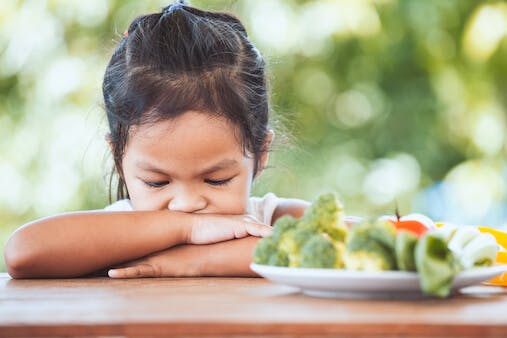
Given the opportunity, starting your baby off with good eating habits is a great way to go. Even if it’s too late for that now, an important lesson from the first feedings still applies: New tastes can be acquired! This is good news for vegetable-haters everywhere.
Lessons from the Crib
If you drink coffee, you probably remember the first time you took a taste. It was horrible! How could anyone like that disgusting stuff! Many baby foods that we consider very bland have the same impact on children. Children have extremely sensitive taste buds. Their vision may have slightly soft focus, but their senses of taste and smell are much sharper than ours. When it comes to introducing new foods, breast-fed babies have an advantage because the taste of mom’s milk varies depending on what she has eaten. Formula-fed babies get the exact same taste every time they drink a bottle, and the introduction of new foods can be more difficult for them. Whichever milk they are fed, new tastes can be acquired.
“My baby hates peas!”
I can’t tell you how many times I’ve heard it.
In an exciting study of1 babies with a demonstrated dislike for peas (perhaps you can picture the expressive faces of the babies enrolled in the study), each was fed peas as the first bite of solid food for the day. If the baby made a disgusted face or spewed the peas, the peas were not continued that day, in favor of other foods the baby liked. The peas were not force-fed. By the end of only 10 days, 85% of the pea-haters had become pea-lovers! They literally giggled at the sight of peas! Take the time early on to give your bundle of joy a delight in peas, green beans, carrots, squash, and sweet potatoes.
The best way to get your infant to eat any new food is to desensitize him or her to the taste. You can accomplish this by using the new food for the first bite of solids each day for 10 days straight.
Older Kids and Adults Vegetable Haters? You Can Learn to Love Vegetables, too!
But what about older kids and adults? Can they learn to love vegetables? Yes! But it takes more exposures in kids and adults than in babies. How long? Up to 89 times. To test the theory, I challenged myself to learn to love one of the vegetable I hated the most — raw cabbage. It took a while, but I now love raw cabbage. In fact, I had it last night for dinner … in the main course.
Never force a child to eat more of a new food than she or he is ready for, but always be ready to scoop up more if the child is still interested! Some new tastes take longer to acquire than others, but continuing to expose your child to small amounts of healthy foods (that the adults in your family) will pave the way for good eating habits in the years to come.
References:
1Effects of Repeated Exposure on Acceptance of Initially Disliked Vegetables in 7-Month Old Infants., Maier, A., Chabanet, C., Schaal, B.,Issanchou, S., Leathwood, P. Food Quality & Preference, 2007, 18:1023–1032.
More Information on Healthy Eating:
Healthy Eating, Part I – How important is good nutrition?
Healthy Eating, Part II – What foods do children need? What foods should be avoided?
Healthy Eating, Part III – The five greatest motivators for preschool children to eat healthy foods.
Healthy Eating, Part IV – Motivators for school age children and adolescents.
Healthy Eating, Part V – Good news for vegetable haters everywhere!
Alan Greene MD


Our goal is to improve children's health by inspiring parents to become knowledgable partners who can work with their children's physicians in new and rich ways.