
How can I get my child to eat vegetables?
Question
I can't seem to get my infant to eat vegetables. Any helpful ideas?
Dr. Greene's Answer
If you drink coffee, you probably remember the first time you took a taste. It was horrible! How could anyone like that disgusting stuff! Many baby foods that we consider very bland have the same impact on children. Children have extremely sensitive taste buds. Their vision may have slightly soft focus, but their sense of taste and smell is much sharper than ours. When it comes to introducing new foods, breast fed babies have an advantage since the taste of mom’s milk varies depending on what she has eaten. Formula fed babies get the exact same taste every time they drink a bottle, and the introduction of new foods can be particularly difficult for them.
It’s normal – even good – for a baby not to like a new vegetable the first several tries. On average it takes 6 to 10 tries during infancy to develop a preference for a new flavor (sometimes, some of these can happen through breast milk or even in the womb). Sadly, 94 percent of parents give up on a new vegetable before they get to 6 tries. Only 1 or 2 parents in a hundred will try 10 times (see Feeding Baby Green).
One way to get your infant to love any new food is to repeatedly expose them to the taste. You can accomplish this by using the new food for their first bite of solids each day for ten days straight. The first day, they may take one mouthful and spit it out. The second day, they may swallow the first mouthful, but may refuse any more of that food. The third and fourth days, they will probably take a few bites, but will undoubtedly want a food to which they are already accustomed. If you continue this pattern for ten consecutive days, most children will acquire a taste for the new food — even vegetables!
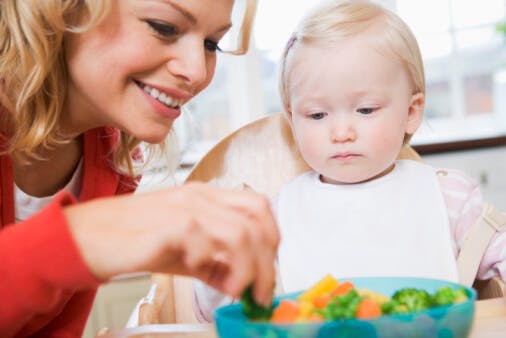
Seeing you eat the same food makes it even more likely they will enjoy it. Mushing some vegetables you are eating (or you eating some of theirs – nonchalantly) can have real power. Don’t try to sell them on it; this just communicates the vegetable isn’t good. But they want to learn what you like to eat. Given a chance to share flavors with you as an infant, kids will learn your food culture in much the same way they learn your language.
- Tip: While your child is in the process of learning to eat a new food, try scooping a small portion of it into a bowl and serving your child from the bowl. If you dip a “used” spoon into food, you can’t store it for later use. Never force a child to eat more of a new food than they are ready for, but always be ready to scoop up more if they are still interested!
Alan Greene MD


Our goal is to improve children's health by inspiring parents to become knowledgable partners who can work with their children's physicians in new and rich ways.