Pose your questions on Ask, Answer, Learn to Dr. Greene and the DrGreene.com community.
Ask DrGreene
Dr. Greene will be chatting live for one hour on Tuesday February 16th at 10:00 a.m. PT (Noon CT) (1:00 p.m. ET). Click Here to chat with Dr. Greene
Fast Fact
Trisomy 13 (also called Patau Syndrome) occurs in up to 1 out of 5,000 newborns (Smith's Recognizable Patterns of Human Malformation, Saunders 1988).
The 13th chromosome contains blueprints that direct a baby's development in the early weeks following conception. When a child has an extra 13th chromosome (three copies, instead of two), as is the case in trisomy 13, the genetic messages are confused and contradictory. This results in multiple significant defects in major organ systems.
The brain is often the most severely affected. Most children with trisomy 13 also have some kind of heart defect. It's not unusual for these children to be born blind, deaf, and with no sense of smell. Children with trisomy 13 may also have abnormalities in the shape of their lips, eyes, ears, fingers, toes, and bones.
Trisomy 13 was first described in 1657, but four hundred fifty years of medical knowledge have not improved the outlook for children born with this syndrome.
Most babies who are conceived with trisomy 13 die early in gestation. Of the babies who live to be born, about 44 % die within the first month and 69% die by six months. Only 18 percent reach their first birthdays -- and these children tend to have severe mental defects and seizures (Smith's Recognizable Patterns of Human Malformation, Saunders 1988).
A blood test, called the AFP (alphafetoprotein) or triple screen, may help a pregnant woman find out her baby’s risk of several diseases, including Trisomy 21 (Down Syndrome) and Trisomy 13, though it can not give a definite answer.
Trisomy 13 is often detectable on ultrasound as early as 10 weeks. Chorionic villous sampling can detect trisomy 13 by 12 weeks. Amniocentesis, usually performed after 16 weeks gestation, can give a definite answer if any question still remains.
A trisomy 13 translocation is not associated with mom's age, but is a hereditary chromosome problem. The risk of recurrence in some types of (balanced) translocations can be quite high.
This is a follow-up to your answer on breastfeeding difficulties. You suggest that a nursing mother pamper herself, and that she get as much sleep as possible. These are great suggestions in general, but why have you specifically made them for a mother who is nursing? I am asking because I know that the more I understand about the reasoning behind something, the more I remember the advice and the more compliant I am.
Anonymous
It's great to hear back from readers. I am always glad to give further explanation!
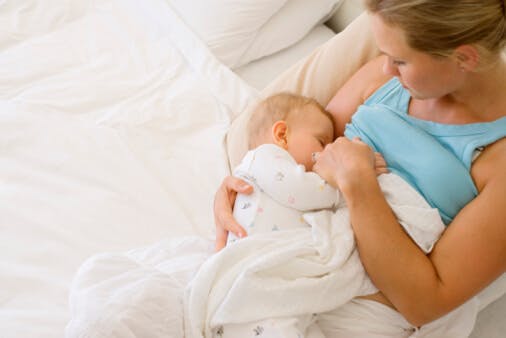
There are several factors that contribute to the success of a nursing experience for mother and baby. One of the most important is that the baby feels satisfied after nursing. This cannot happen if the mother is not making enough milk to fill the baby up, or if the baby is not able to successfully get the milk that is there.
When a mother is stressed or sleep deprived, her body cannot make milk as well as it does when she is relaxed and rested. In addition, when a mother is tense or tired, the milk she has made will not flow as quickly and easily in response to her baby's sucking. Also, even very young babies have the ability to pick up on their mothers' cues. Babies tend to be much fussier when their mothers are out of sorts, making the whole experience much more difficult. Not only will the breast feeding session last much longer than necessary, often the baby will fall asleep from exhaustion, only to wake up hungry after a brief nap.
When her baby cries, a mother becomes measurably more tense. When a mother becomes more tense, her baby's crying accelerates. The best way to break this vicious cycle is for the mother to boldly take care of herself. Sleep when the baby sleeps. Let others take care of the chores. This seemingly selfish move will actually enable her to love and enjoy her baby with fresh patience, enthusiasm, and skill.
House dust mites are tiny creatures that live in pillows and mattresses, carpets, and couches – quietly eating dead skin cells and hair. Click here for tips on taking control of dust mites
So should we be concerned about a little boy who wants to be called a girl...
I walked without crawling when I was a kid and I think my daughter is on the...
I'm sure you will check with the baby's pediatrician, but you can also check...
Does she have any friends or cousins who are potty trained? My daughter...