
Making Blood Draws Easier for Kids
Question
I'm the parent of a 2 year old child with biliary atresia. Kids with liver disease are subjected to frequent blood draws. Do you have any tips for parents on how to make them as bearable as possible? In the lab at my child's last appointment I heard a mother telling her 3 year old daughter "Now what did I tell you? We're not going to McDonald's if you start crying!" The lab technician was trying to comfort the child, telling her at the same time "It's okay to cry, we know this hurts." It was very sad to watch. Also, do you have advice for parents on when and how to get assertive in the lab when things aren't going well, (i.e. how many tries should we allow before we stand up and say "Get another technician" etc.).
Dorothy Bourdon - Attica, Michigan
Dr. Greene's Answer
The amount of information that can be gleaned from a small amount of blood is truly amazing. This information can literally make the difference between life and death. Unfortunately, for many children, their fear of the needle stick required to obtain that small amount of blood is greater than their fear of death itself.
The first step in making blood draws (and other needle sticks) more bearable for your child is to put yourself in your child’s place. Obviously, Dorothy, you already do this, but the mother who threatened to skip McDonald’s if her little girl didn’t stop crying wasn’t able to feel the fear and pain her daughter was experiencing.
A child’s degree of needle fear changes at different developmental stages. And each individual child’s fear is affected by his or her past experiences. Most children who require frequent blood draws will inevitably have a bad experience — a technician misses the vein, digs to find it, then the child begins to cry and tries to escape from the pain, the technician tries harder, etc. Finally someone gets the needed blood and the child is no longer tormented, but the terror of the experience goes with the child. The next time someone attempts to draw blood from the child, the whole experience is revisited, bringing tension into every muscle of his or her body.
In general, it is much more difficult to draw blood from children than from adults, due to the relative size of their veins. Unlike children, most adults can reason with their fears. As adults, we can understand the need for the tests our doctors recommend. We may not be able to completely divorce ourselves from negative past experiences, but we can tell ourselves that it probably won’t be as bad this time as it was last time. We know that if it is not going well we can demand a different technician, and as a last resort, we can get up and walk out. That level of control makes the experience far more manageable for adults than for children. At most developmental stages, most children don’t have the ability to reason with their fears. As children, they can’t demand better service, and they feel powerless to change the course of events.
As parents, we not only have power over our own medical care, but also over that of our children. As your child’s guardian, there are several things you can do to make the experience better for them:
- Mirror your child’s emotions back to him or her. If your child begins to act out before you even get to the lab, stop and talk about how he or she is feeling. You might begin by saying, “You are acting as if you are angry.” Usually a child will respond to these kinds of statements with something like, “Yeah, I’m mad.” You can keep the conversation focused by drawing out further emotions: “It really doesn’t seem fair, does it?” “No. Why do I have to always get stuck?!”
- Let your child know that you accept his or her emotions. Don’t say something like, “Now it’s time to be a big girl.” Instead say, “I understand why you are angry.”
Get your child involved in a solution — “Since we’ve got to get this blood test, how can we work together to make it as easy as possible?” Even very young children can brainstorm, and when they are involved in coming up with a solution, they try harder to make it work. Here are some things you might suggest during the brainstorming session:
- Your child could sit on your lap during the blood draw.
- You could stand behind him or her and give a shoulder rub during the draw.
- You could hold his or her “other” hand.
- You could hold your finger up like a candle and let your child blow it out when the needle goes in. Make a game out of it — that pesky flame won’t go out easily, so your child needs to blow and blow until the blood draw is over. (This is similar to Lamaze breathing.)
- You could do a tap dance during the draw to distract him or her (this is especially good if you can’t dance and your child knows it!)
- You could tell his or her favorite story.
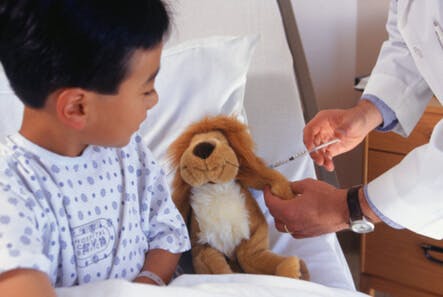
- You could let your child pretend to draw blood from his or her teddy bear. Be sure to ask how the teddy bear is feeling. If the teddy bear hurts (which I’m sure he will!), ask your child to think of things that could be done to make teddy feel better.
- You could leave the room — sometimes older kids would prefer this; it makes them feel grown up.
Do everything you can to get your child to relax before the blood draw. It is much easier to get the stick if both the child and the lab tech are relaxed:
- Leave plenty of time to get to the lab. If you are tense in traffic, your child will get tense, too.
- Play soothing music in the car on the way to the lab.
- If possible, make it a one-on-one time with the child who is getting the test — leave siblings with a sitter.
- Distract your child with a fun game.
Make friends with the lab technicians! This one is important!!! Lab technicians dread aggressive parents. Having to deal with aggressive parents makes them tense and they miss more often.
- Visit the lab without your child and watch (without being noticed) how different people interact with patients. When they do notice you and ask if they can help you, simply explain that your child is going to need frequent blood work from their lab and you wanted to become familiar with the physical layout of the lab before bringing him or her so that your first trip would be as easy as possible.
- Learn the names of the people who work in the lab. If one seems particularly good, ask for him or her by name. People are always honored when you do that, and they try to give you better service.
- Treat the people who work at the lab with respect.
- Bring them goodies from time to time.
- Thank them for their time and work.
- Let your child know that you will make sure he or she gets the best possible treatment. In general, I recommend two (maybe three) tries before requesting someone new. If your child is dehydrated, the veins may be particularly difficult to find, and it is better to let someone who has “gotten to know” the current status of your child’s veins try a third time than to get a new person involved. Sometimes, even when your child’s veins are in great shape, your favorite technician will miss. Maybe he or she is having an off day. There is nothing wrong with requesting that someone else take over, IF you do it nicely. “I’ve promised my son that I won’t let anyone stick him more than twice. I know you usually get it the first time, but I really need to keep my word to my son, so I hope you won’t mind getting your supervisor. If she’s busy, we’ll be glad to wait.”
- If your child becomes upset during the blood draw, give him or her options (if your child is old enough to understand what’s going on). Ask if he or she would feel better if we all took a little break, or would it be better just to get it over with. Let your child know that not doing it at all isn’t an option.
- Focus on your child’s needs. Don’t be concerned with what the other people in the lab may think about you and your child. If your child is crying, cry with him or her. If your child is kicking and screaming, gently hold him or her with your mouth near his or her ear. Quietly sing your favorite lullaby, even if your child is “too old” for lullabies.
- When it is all over, tell your child that you are proud of him or her. Going through that kind of experience is heroic — no matter how he or she acted during the draw.
There is also a topical anesthetic called EMLA cream that will numb the skin and make the needle stick more comfortable. It must be applied one to two hours before the procedure. Ela-Max is a similar cream that requires less time to work. However, EMLA and Ela-Max are not routinely used for blood draws and can add to a child’s anxiety, because he or she may begin to think about (and often dread) the experience during the preparation period.
Frequent blood draws can become a major emotional issue for children. If your child is already “deathly” afraid of needles or if he or she comes to that point, you may want to seek the help of professionals. Most children’s hospitals have a Child Life department with trained specialists. These departments often offer classes for patients and may be able to facilitate participation for out-patients as well. If they are not, they will be able to recommend psychologists in your area who can help your child work through his or her fears.
I know how difficult it is to watch someone you love very much go through a long illness that requires frequent needle sticks. I also know that your child is not the only one who experiences fear and pain with each stick. Dorothy, I know this whole experience is very difficult for you, too. In some ways, it would be easier for you to be sick yourself, instead of your child. What you are going through is heroic, and I’m proud of you, too.
Alan Greene MD


Our goal is to improve children's health by inspiring parents to become knowledgable partners who can work with their children's physicians in new and rich ways.