
Battery Safety
Question
Dr. Greene, we need medical assistance -- hurry! The situation is as follows: - A little girl, 11 months, arrived to the Children's Hospital. She had eaten a battery of a remote control (TV) that was picked up after 12 hours in the esophagus. There was an intoxication with mercury and acid. The situation now is perforations in windpipe and esophagus, with septicemia. She is in the intensive therapy, seriously but stable. We need information about:
- similar cases in the world
- possible antidotes
- products the battery contains and their effects when they're eaten.
Dr.Notti Martin Echeverria - Mendoza, Argentina
Dr. Greene's Answer
How agonizing for the parents to watch their daughter suffer so! And over a tragedy that came so close to not being a problem.
Babies love to explore the world with their mouths. This is especially true of infants during those precious, fleeting months that they crawl across the floor, but is common for kids up to the age of 4. These young children will come upon something interesting, and then put it in their mouths to sample. Most of these episodes are nothing more than happy parts of growing up.
Sometimes, however, the attractive object can poison or choke the child. In the United States approximately 1.4 million childhood poisonings are reported each year — most commonly from cosmetics or personal care products, cleaning or polishing agents, plants, pesticides, fertilizers, foreign bodies and medicines (2006 Annual Report of the American Association of Poison Control Centers’ National Poison Data System, Clinical Toxicology, Dec 2007). And choking is the most common cause of accidental death in children under the age of one.
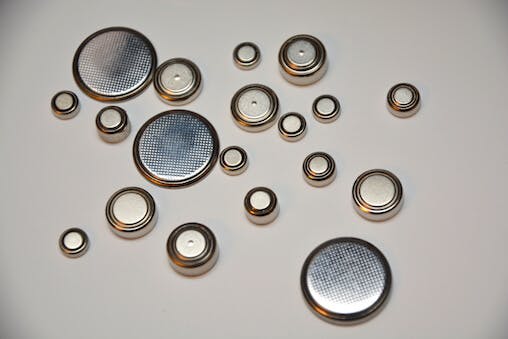
Very enticing are smooth, bright, shiny objects such as batteries — especially the small disc-shaped batteries now found in many cameras, watches and electronic devices. These little buttons look harmless, but can be quite lethal. The same is true of larger batteries, but they are less frequently swallowed. According to the National Capital Poison Center, 3,500 people swallow button batteries each year (www.poison.org/battery/).
In the United States there is a 24-hour emergency consultation service called the National Button Battery Ingestion Hotline (202-625-3333). Over a 7-year period they followed 2382 cases of swallowed batteries. Of these, 62 were larger cylindrical batteries, and the rest were buttons. Hearing aids were the most common source of batteries swallowed. Most kids who swallowed batteries had no problems. Only 9.9% had symptoms suggesting injury (abdominal pain, vomiting, bloody stools). In this series, only 2 children had very severe esophageal burns (Pediatrics, Apr 4, 1992).
Batteries contain powerful alkaline corrosives that can cause severe burns if they leak inside the body. Different batteries contain different ingredients. Among the most common are lithium, manganese dioxide, silver oxide, and zinc. Of these, lithium and manganese dioxide usually cause the most severe burns.
Mercuric oxide batteries were once a major concern, but the United States government banned them in 1996. When the mercuric oxide batteries leak and fragment, they can cause mercury intoxication as well as burns. Mercury poisoning creates a wide variety of problems, but often begins with vomiting, bloody diarrhea, and severe abdominal pain. It can proceed to decay of the walls of the intestines, vomiting blood, shock, and death. Chronic exposure to high levels of mercury salts causes irritability, kidney disease, colitis, and drooling. Treatment is aimed at lowering the mercury levels with chelator drugs.
In general, relatively larger batteries are more likely to cause symptoms than smaller batteries.
Even when the batteries don’t leak, the electrical current passing through the moist tissue of the body can cause significant injury.
Controversy shrouds the best way to manage these ingestions. Some recommend urgent surgery or endoscopy to remove all batteries. Others recommend observation alone. I agree with the moderate approach counseled by the National Capital Poison Center.
For battery ingestions call the Battery Ingestion Hotline right away at (202) 625-3333. Of course, most people aren’t aware of this hotline. The Poison Control Hotline is a more general resource whenever a child swallows something potentially dangerous. For poisoning emergencies throughout the United States, call 1-800-222-1222. They will give immediate advice to you, and be available to advise your physicians as well.
If possible, provide the Battery Ingestion Hotline or the Poison Control Center with the battery identification number from either the packaging or a matching battery. This will help determine the size and content of the battery.
Syrup of Ipecac is not recommended for swallowed batteries. This (as well as other substances) has been given to induce vomiting in the hopes of ejecting the battery. This approach doesn’t work and may make the situation worse.
Bring the child to the Emergency Room. I recommend that all children who swallow batteries receive a chest x-ray to locate the batteries (on a cost analysis this isn’t wise, since the many kids who received unnecessary x-rays would cost more than the few catastrophes it could prevent; but on a risk-benefit analysis I believe it to be very wise).
If the battery is in the esophagus, or the child is having pain, severe vomiting, or bleeding, then the battery should be removed at once. If the battery has fragmented and might contain mercuric oxide or the child develops signs and symptoms of mercury poisoning, then blood mercury levels should be followed. On the other hand, if the battery has passed intact into the stomach or beyond, then almost all kids will be fine. Laxatives can be given to help move the battery along more quickly, although most batteries will pass through the gut unaided. And stools are observed (what a pleasant job) until the battery has passed. In 85% of cases, the batteries have passed by the end of 4 days.
Severe burns can occur when the battery sits in the esophagus without moving. These children are critically ill. Whenever treatment questions exist about a critically ill child, there are hotlines devoted to giving specific advice based on up-to the minute information about the child. I’ve been quite impressed with the hotline (800) ICU-Kids from Children’s Hospital Oakland.
Your question is a sobering reminder for all of us to be vigilant about what hazards our children have access to. Internal burns can be a devastating problem. It sounds like this little girl’s condition is grave, but that if the infection is treated, slow healing of her insides can take place. She may need surgery or tissue grafts. There will be scars, both physical and emotional, but there is also real hope.
Alan Greene MD


Our goal is to improve children's health by inspiring parents to become knowledgable partners who can work with their children's physicians in new and rich ways.