
Jaundice: A-to-Z Guide from Diagnosis to Treatment to Prevention
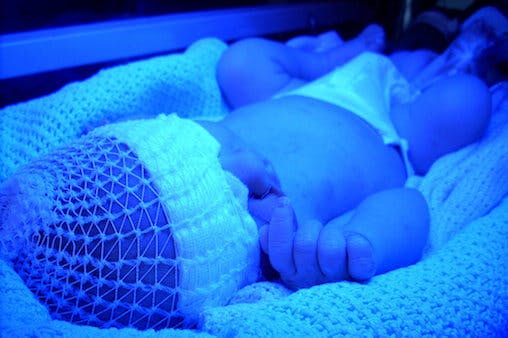
Jaundice is common in new babies and is usually not a problem. Nevertheless, it can be a sign of a serious disease and occasionally it can cause lasting nerve damage. Parents need to know when to worry and when to relax.
What is it?
Jaundice is a yellow color observed in the skin or in the eyes. The yellow pigment is a byproduct of old red blood cells that is called bilirubin. If you’ve ever had a bruise, you may have observed that the damaged red blood cells in the skin went through a series of color changes as the skin healed. When you saw yellow in the bruise, you were seeing bilirubin.
Most of the time, about one percent of our red blood cells retire every day, to be replaced by the same number of fresh, young red blood cells. The old ones are processed in the liver as they are disposed of. Much of the bilirubin leaves the body in the stool.
If there are too many red blood cells retiring for the liver to handle, yellow pigment builds up in the body. When there is enough to be visible, the yellow skin color results.
It can be caused by too many red blood cells retiring, by the liver being unable to perform its job efficiently, or by a combination of the two. Dehydration or decreased stooling can accelerate the build-up of bilirubin concentrations and make it get worse quickly.
Who gets it?
Most babies have some jaundice during the first week of life. The ordeal of birth can send many red blood cells to an early retirement (especially if a vacuum is used!), and babies’ livers are often unprepared for the load. Before Mom’s milk comes in and stooling begins in earnest, bilirubin accumulates more easily.
It is even more common in premature babies.
Physiologic jaundice is the name for the normal type commonly seen in healthy babies.
Pathologic jaundice is the name given when the jaundice is a risk to the baby, either because of its degree or its cause. Pathologic jaundice arises for many reasons, including blood incompatibilities, blood diseases, genetic syndromes, liver diseases, infections, medications, or physiologic jaundice exaggerated for some reason (such as dehydration, prematurity, or a difficult delivery).
Two types are related to breastfeeding. They are called breastfeeding jaundice and breast milk jaundice.
What are the symptoms?
Jaundice often becomes visible on the face when the bilirubin level is about 5 mg/dL. It can be seen from the head down to the belly when the bilirubin is about 15 mg/dL, and all the way to the soles of the feet at about 20 mg/dL.
Physiologic jaundice in a term baby usually first appears when a baby is two or three days old. It peaks by day 4 and usually does not continue below the belly.
The rate of bilirubin rises less than 5 mg/dL per day. The baby with physiologic jaundice should have no other symptoms.
Pathologic jaundice either appears earlier, later, rises faster, reaches higher levels, lasts longer, or is accompanied by other symptoms (perhaps vomiting, dark urine, lethargy, too much weight loss, abnormal body temperature, etc.). Jaundice that first appears on day 4-6 is often caused by sepsis or a urinary tract infection.
Breastfeeding jaundice may occur in the first week of life in more than 1 in 10 breastfed infants. The cause of breastfeeding jaundice is thought to be decreased milk intake leading to dehydration or low caloric intake. It is a type of physiologic or exaggerated physiologic jaundice.
Breast milk jaundice is far less common and occurs in about 1 in 200 babies. Here the jaundice isn’t usually visible until the baby is a week old and it often reaches its peak during the second or third week. Breast milk jaundice can be caused by substances in mom’s milk that decrease the infant’s liver’s ability to deal with bilirubin. Breast milk jaundice rarely causes any problems, whether it is treated or not.
Is it contagious?
It is not contagious, although some of the underlying causes may be.
How long does it last?
Physiologic jaundice usually peaks by day 4 as the baby’s liver gains control of the situation. It is usually gone by day 7.
Pathologic jaundice may continue to increase until either the jaundice or the underlying problem is treated.
Breast milk jaundice will decrease and disappear on its own, but this may take 3 to 10 weeks.
How is it diagnosed?
A general diagnosis may be made by physical examination. The skin is gently pressed to observe the coloring when the skin blanches.
A specific diagnosis is based on measuring bilirubin levels. In newborns, the results may be plotted on a graph with the age of the baby in hours. This can predict how likely the bilirubin is to rise to pathologic levels.
Attention should be paid to other risk factors that might make the jaundice worse, including prematurity, excessive weight loss, or a traumatic delivery. Further work-up may be necessary to identify the underlying cause of pathologic jaundice.
How is it treated?
Phototherapy is the primary treatment for pathologic jaundice. High intensity light of the right wavelength converts the bilirubin pigment to a safer form that is easily removed from the body and does not build up to toxic levels. Bright light can fade the pigments in your couch; in much the same way, special fluorescent-like lights can fade the unhealthy pigment in your baby.
In addition to the phototherapy, it is important to keep the baby well hydrated and to identify and treat any underlying problems.
When phototherapy is not reducing the bilirubin levels appropriately, a special type of blood transfusion (an exchange transfusion) is sometimes needed. This is quite uncommon.
How can it be prevented?
The important thing to prevent is kernicterus, toxic levels of bilirubin accumulating in the brain. Identifying pathologic jaundice and instituting treatment early will usually prevent kernicterus.
Frequent feedings and avoiding dehydration can prevent jaundice for some babies.
Related concepts:
Bilirubin, Breast milk jaundice, Breastfeeding jaundice, Hyperbilirubinemia, Kernicterus, Neonatal Jaundice, Pathologic jaundice, Physiologic jaundice.
Alan Greene MD


Our goal is to improve children's health by inspiring parents to become knowledgable partners who can work with their children's physicians in new and rich ways.