
Fractures: A-to-Z Guide from Diagnosis to Treatment to Prevention
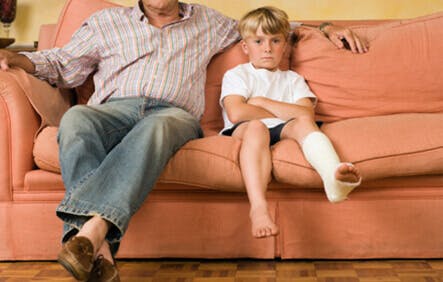
Children love to run and climb and jump. But sometimes they also fall and twist and get hurt. Sometimes it’s a ligament that is damaged, sometimes it’s a muscle, often it is a bone.
What are fractures?
A fracture is a break in a bone. There are many different types of fractures and they can behave quite differently.
A buckle or torus fracture is an injury to the bone that buckles, bends, or twists the bone without cracking through the outer layer.
A greenstick fracture bends a long bone enough to crack one side, but not the other, rather like bending a green piece of wood.
A complete fracture breaks a bone through –and through. It is “displaced” if the two ends no longer line up well. It is “non-displaced” if the two ends remain in a good position for healing. In a closed fracture, the overlying skin is intact; in an open or compound fracture, the bone sticks through the skin.
An avulsion fracture is one where a bit of bone is pulled off.
Salter fractures, or epiphyseal fractures, are those that involve the growth plates of the bone. These are divided into five subtypes that require different types of treatment.
Most of the time, broken bones in children heal quickly and well.
Who gets them?
Fractures are very, very common in children. Unlike adults, in children fractures are more common than sprains. In general, children’s fibrous ligaments are even stronger than the growing parts of their bones.
Falls cause most fractures, especially in young children, but car crashes usually cause the worst fractures.
A broken finger is usually caused by a direct blow to the finger.
A broken wrist or lower arm is usually the result of falling forward onto an outstretched hand. This is a classic childhood fracture.
A fracture in the upper arm often comes from falling backwards and breaking the fall with the elbow.
Collarbone (clavicle) fractures are common injuries that occur during birth – evidence of the powerful forces at work during labor.
Fractures of the legs, especially the lower legs, often come from simple falls during active play.
Ankle fractures are common in children. They may appear to be sprains. Because the growing part of the ankle bones is weaker than the fibrous ligaments in the ankle, the same injury that may cause a sprain in an adult may cause a fracture in a child.
A fracture of the foot usually comes from a direct blow, especially in a barefoot child.
What are the symptoms?
Fractures are often, but not always, accompanied by swelling, pain, bruising, and difficulty moving the affected bone.
Are they contagious?
No – although the behavior that leads to fractures may be.
How long do fractures last?
The length of time needed for healing varies depending on the location and the severity of the fracture. A torus fracture of the wrist may heal in only 3 weeks. An ankle fracture involving a growth plate may take twice as long.
How are fractures diagnosed?
Sometimes a fracture is immediately obvious. Other times, fractures can be difficult to diagnose in children. X-rays are often needed to diagnose and characterize a fracture.
How are fractures treated?
Children’s bones heal quickly and well. Most fractures will heal on their own with simple immobilization in a cast or splint. Some fractures, such as those in the fingers or toes, might heal well with only “buddy taping” (taping the broken digit to one next to it for stabilization).
Occasionally fractures need to be “set” to realign the bones. Surgery is sometimes needed, either to align the bones or to stabilize them. This is much less frequent in children than in adults.
How can fractures be prevented?
Sports and active play are wonderful for children.
Adult supervision and appropriate safety equipment can help prevent fractures. Helmets, elbow and wrist guards, etc., can keep bones intact.
Stair gates for infants and toddlers and car seats or seat belts for everyone in the car are also important safety equipment.
Falls from open windows, rooftops, balconies, play structures, and other heights break more bones in children than any other cause.
Summertime is the greatest danger period, with more open windows and more outdoor play. Children love to climb, so furniture is best kept back from windowsills and balcony railings. Window guards and window stops can let fresh air in but keep a child from falling out. Don’t rely on ordinary window screens to keep your children safe. In addition, placing shrubbery or something soft under danger areas can lesson the injury if a child does fall.
Related concepts:
Avulsion fracture, Broken Bones, Buckle fracture, Clavicle fracture, Compound fracture, Displaced fracture, Epiphyseal fracture, Greenstick fracture, Non-displaced fracture, Open fracture, Salter fracture, Torus fracture.
Alan Greene MD


Our goal is to improve children's health by inspiring parents to become knowledgable partners who can work with their children's physicians in new and rich ways.