Pose your questions on Ask, Answer, Learn to Dr. Greene and the DrGreene.com community.
Ask DrGreene
Dr. Greene will be chatting live for one hour on Tuesday February 16th at 10:00 a.m. PT (Noon CT) (1:00 p.m. ET). Click Here to chat with Dr. Greene
Fast Fact
Most bacteria and viruses that cause infections in humans thrive best at 98.6 degrees F (37C). Raising the temperature a few degrees can give the body the winning edge. In addition, a fever activates the body's immune system, accelerating the production of white blood cells, antibodies, and many other infection-fighting agents.
Brain damage from a fever will not occur unless the fever is over 107.6 degrees F (42C) for an extended period of time.
Untreated fevers caused by infection will seldom go over 105 degrees unless the child is overdressed or trapped in a hot place. In a neurologically normal child, the brain's thermostat will stop the fever from climbing above 106 degrees F.
· About 4% of children will sometimes have seizures with fever. These febrile seizures are caused by rapid increase in temperature, not by the height of the temperature. Once a child already has a high fever and a febrile seizure, a febrile seizure is unlikely to reoccur with the current illness. In any event, typical febrile seizures are over in moments with no lasting consequences.
While 98.6 degrees F is considered the normal core body temperature, this value varies between individuals and throughout the day. The daily variation is minimal in children less than six months of age, about 1 degree in children 6 months to 2 years old, and gradually increases to 2 degrees per day by age six. A person's baseline temperature is usually highest in the evening. Body temperature, especially in children, is normally raised by physical activity, strong emotion, eating, heavy clothing, elevated room temperature, and elevated humidity. Rectal temperatures below 100.4 degrees F (38C) may be entirely normal (no fever). A rectal temperature of 100.4 or above should be considered a fever. Lower values might be a fever, depending on the child.
A fever does not necessarily need to be treated. If a child is playful and comfortable, drinking plenty of fluids, and able to sleep, fever treatment is not likely to be helpful.
Steps should be taken to lower a fever if the child is uncomfortable, vomiting, dehydrated, or having difficulty sleeping. The goal is to bring the temperature between about 100 and 102 degrees F -- not to eliminate the fever.
When trying to reduce a fever, first remove excess clothing or blankets. The environment should be comfortably cool (one layer of light weight clothing, and one lightweight blanket to sleep).
Two medicines are useful for reducing fever in children: acetaminophen (Tylenol) and ibuprofen (Children's Advil or Motrin). Acetaminophen is given every 4-6 hours, and works by turning down the brain's thermostat. Don't use under three months of age without first having the child examined by a physician. Ibuprofen is given every 6-8 hours, and helps fight the inflammation at the source of the fever. It is not approved for children under 6 months. Both medicines may be given for stubborn fevers, but be very careful about using the correct dose of each.
A lukewarm bath or sponge bath may help cool a febrile child (after medication is given -- otherwise the temperature bounces right back up). Cold baths or alcohol rubs cool the skin, but often make the situation worse by causing shivering, which raises the core body temperature.
Fever is a signal that something is going on in your child. Usually this is a minor illness, but it can be a serious infection, such as meningitis. Any child less than 90 days old with a fever should be examined by a physician right away, to rule out a serious infection (unless there was a DPT shot in the previous 24 hours). Children of any age who have a fever 104 degrees or more should also be seen, unless the fever comes down readily with treatment and the child is comfortable. Any child who has a fever and is very irritable, ill appearing, confused, has difficulty breathing, has a stiff neck, won't move an arm or leg, or who has a seizure should also be seen right away.
Even without the above symptoms, children under 6 months of age with a fever should be examined by a physician within 24 hours (again unless they just had a DPT), since they may have some infection that needs to be treated. Older children with a fever (6 to 24 months old) who are acting well and have no other symptoms should be seen if the fever lasts >48 hours (or >72 hours if they do have minor cold or flu symptoms).
Children with significant astigmatism have to work harder to see well. This can lead to eyestrain, fatigue, and even headaches.
What is astigmatism?
Rays of light that enter the eye are supposed to be focused by the cornea and the lens to land on the retina, so that we can see clearly. In the real world, the cornea and lens are not exactly symmetrical. Irregularities in the curve of the cornea or lens make vision clearer in some planes than others. This asymmetry of vision is called astigmatism.
Who gets astigmatism?
Most or all of us have some degree of astigmatism. In most people it is so mild an asymmetry that it causes no symptoms. Some have astigmatism that has a significant impact on vision. Significant astigmatism tends to run in families.
What are the symptoms of astigmatism?
Mild astigmatism may produce no symptoms. The greater the astigmatism, the greater the distortion of vision – both near and far. Astigmatism can cause significant blurring.
Children with astigmatism may be too young to notice or describe astigmatism. They may frown, squint, or pull objects close (to constrict the pupils) in order to try to get a clearer picture. They may also tilt or turn their head. This extra work may lead to eyestrain, fatigue, or headaches.
Is astigmatism contagious?
No
How long does astigmatism last?
Astigmatism may be a lifelong condition. It may also improve or worsen as the eyeball grows and matures.
How is astigmatism diagnosed?
The degree of astigmatism can be measured accurately at any age, without cooperation from the child. The eyes often need to be dilated for the examination.
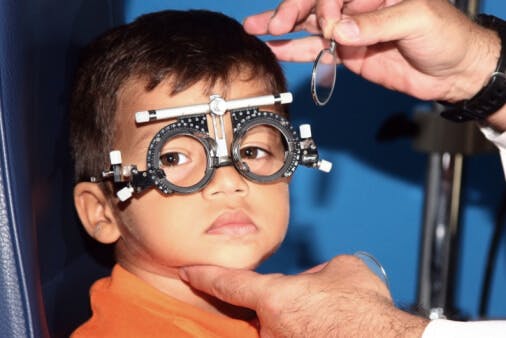
In older children, astigmatism is sometimes measured by placing different shaped lenses in front of the eye, and asking which one allows them to see better. A cylindrical or sphero-cylindrical lens may make vision clearer for someone with astigmatism.
How is astigmatism treated?
Glasses (or contact lenses) may be needed some or all of the time, depending on the extent of the visual distortion and any symptoms resulting from working harder to get a clear image.
How can astigmatism be prevented?
Astigmatism is difficult to prevent. Years of poor vision or extra work can be prevented by vision screening. In addition, children whose families have a history of significant astigmatism should have a formal eye exam at an early age.
Each day I see parents trying their best to do what’s right for their families, but no one has the perfect guidebook that tells parents what to do. Click here for the top ten solvable problems that I advise parents to remedy today.
So should we be concerned about a little boy who wants to be called a girl...
I walked without crawling when I was a kid and I think my daughter is on the...
I'm sure you will check with the baby's pediatrician, but you can also check...
Does she have any friends or cousins who are potty trained? My daughter...