
Dr. Greene’s Organic Rx — Item #2
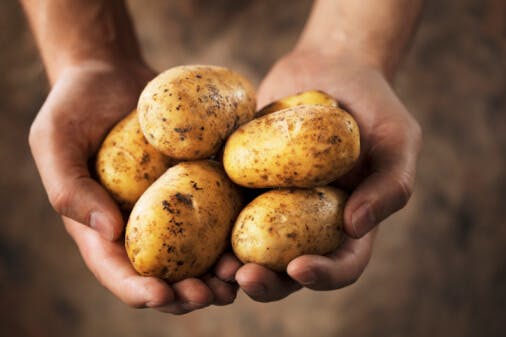
#2 Organic Potatoes
For some cultures, the staple food is rice; for some it is maize. For American children, the staple food is the French fry! Potatoes are consistently on the list of most pesticide-contaminated vegetables. In recent USDA testing, the Environmental Working Group found that 81% of potatoes still contained pesticides after being washed and peeled, and the average potato had the highest total amount of pesticides of all of the 43 fruits and vegetable tested12.
Organic potatoes make my list because by the time American kids are 18 to 24 months old potatoes are the most commonly eaten vegetables, mostly in the form of French fries13. This gives a big opportunity to exert our power to bring about change.
And potatoes aren’t just for kids. When surveyed, adults in the US reported eating an average of 3.6 servings of vegetables a day, with white potatoes leading the pack, accounting for about 30% of vegetables consumed14.
All of these potatoes represent well over a million acres of potato farms, yet there are only 6581 acres of organic potato production15 – actually less than there were in 2004, or even back in 2001. We’re going potato-backwards! Even though potatoes are the number one vegetable, and even though they can have the highest total amount of pesticides, someone must think we don’t want organic potatoes enough to push for them.
Let’s change that. If you go to a drive-thru or a restaurant, and they don’t have organic potatoes, choose another side dish. If enough of us do this, restaurant operators will either switch to organic potatoes, or provide other tasty, healthy side dishes.
If a lot of us just change item #1, I’ll be happy. If we change #1 and #2, I’ll be thrilled.
Read more from this series
- Dr. Greene’s Organic Rx — What you need to know!
- Dr. Greene’s Organic Rx — Item #1 — Milk
- Dr. Greene’s Organic Rx — Item #2 — Potatoes
- Dr. Greene’s Organic Rx — Item #3 — Peanut Butter
- Dr. Greene’s Organic Rx — Item #4 — Baby Foods
- Dr. Greene’s Organic Rx — Item #5 — Catsup
- Dr. Greene’s Organic Rx — Item #6 — Cotton
- Dr. Greene’s Organic Rx — Item #7 — Apples
- Dr. Greene’s Organic Rx — Item #8 — Beef
- Dr. Greene’s Organic Rx — Item #9 — Soy
- Dr. Greene’s Organic Rx — Item #10 — Corn
- Dr. Greene’s Organic Rx — Bonus Item #11 — Wine
12Environmental Working Group. Test Results: Complete Data Set. Shopper’s Guide to Pesticides in Produce. 4th edition. 2006.http://www.foodnews.org/fulldataset.php accessed Feb 5, 2007
13Fox MK, Pac S, Devaney B, Jankowski L. Feeding Infants and Toddlers Study: What foods are infants and toddlers eating? J Am Diet Assoc. 2004 Jan; 104 (1S):22-30.
14Johnston CS, Taylor CA, Hampl JS. More Americans are eating “5 a day” but intakes of dark green and cruciferous vegetables remain low. J Nutr. 2000 Dec;130(12):3063-7.
15Certified organic and total U.S. acreage, selected crops and livestock, 1995-2005. USDA. December 15, 2006.
Alan Greene MD


Our goal is to improve children's health by inspiring parents to become knowledgable partners who can work with their children's physicians in new and rich ways.