
Grebe Syndrome
Question
Dr. Greene, Wonderful home page! I am the editor of a chain of newspapers in South Alabama and this morning a woman came into my office with a most interesting story. Her daughter is five months pregnant and recently went for ultrasound. To the daughter's shock she was informed that her baby daughter will be born without arms or legs. Further extensive tests at University of Alabama-Birmingham Medical Center, a first-rate facility, confirmed the initial diagnosis of Grebe syndrome. We are doing an article on the girl so fund-raising can begin to help with what will be extensive medical bills. Can you give me some information on this syndrome to tell our readers? There are very few references as apparently it is an extremely rare syndrome. Thank you.
Jay Felsberg - Editor - Geneva Publications - Geneva, Alabama
Dr. Greene's Answer
Pregnancy is one of the most vivid seasons of human life, a time when a woman is sharing an experience with her ancestors all the way back to those before recorded history. In just this last generation, many women have added an intense new moment to the experience of pregnancy — the prenatal ultrasound.
During the prenatal ultrasound, as a mom sees and hears the beating of her baby’s heart, the growing bond with her unborn child is accelerated. For many dads, this is the first moment that they are aware of bonding. It’s powerful to see that your baby is alive and okay. Parents look on with delight as the ultrasonographer points out the head, the hands and the feet. Usually.
For some parents, the ultrasound is the clenching moment when they first discover something is not going right. The mother you describe must have seen a baby with a normal head and face, a normal heart, but no arms and legs. Thus began her long and difficult process of preparing to welcome this particular baby into the world.
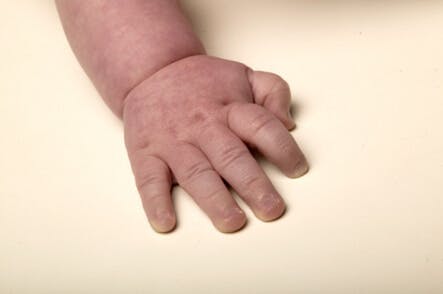
Grebe syndrome is a very rare form of short-limbed dwarfism. It is a genetic condition, passed by autosomal recessive inheritance (both parents carry a recessive gene, and 1/4 of their offspring will be affected). The largest cluster of people with Grebe syndrome are in Brazil. The condition was first described in 1952, and initially called achondrogenesis — Brazilian or Grebe type. Today Grebe syndrome bears the name of its discoverer. It is very closely related to a number of other forms of dwarfism, some of which are associated with other major medical problems. Misdiagnosis is common. In one series of three patients with Grebe syndrome (which is a lot for this rare disease), two of them later turned out to have other, more serious types of dwarfism (Journal of Pediatrics, Dec 1977).
Children with Grebe syndrome have normal intelligence, normal emotions, and go through puberty normally. In fact, the only consistent abnormality is missing or greatly shortened limbs. In the most common form, children have extremely short lower legs and arms, with little nubbins of fingers and toes on the ends. Most walk relatively normally.
The situation of the little girl you describe is quite severe. Being born without arms and legs will affect everything that new person does forever. There will be no grabbing a crayon and coloring a picture for Mommy — there will be no grabbing anything. There will be no soccer games, no running in the grass, no climbing a tree.
Raising a child with no arms and legs takes extraordinary care and attention. Most parents are used to the round-the-clock responsibility of having to feed and change a baby, but know that one day the baby will begin to feed herself and go to the bathroom by herself. Kids without arms and legs will always need someone to feed them and change them. Thankfully, there are exciting new devices being developed all the time that can make a tremendous difference in the lives of children. Sophisticated artificial limbs might be an option, depending on the anatomy. A boy I knew who had lost all use of his arms and legs was soaring on cloud nine when he got a new computer/typewriter designed for him. He was able to type simply by looking at the letters on the keyboard.
Working with scientists and physicians (especially physiatrists) at the university, the child you’ve asked about can be fitted with the best devices to help at each stage of growth. It’s possible that creative surgery might also improve her capabilities.
A long road lies ahead. I’m glad that the mother, her family, and the community can begin now to welcome this special child and to help facilitate a unique and rich life. Thanks, Jay, for your vital role in supporting and encouraging the community’s role in the process.
Alan Greene MD


Our goal is to improve children's health by inspiring parents to become knowledgable partners who can work with their children's physicians in new and rich ways.