
Cold Urticaria
Question
My doctor says my little girl may have cold urticaria. What is this, exactly? How should I treat it?
Dr. Greene`s Answer:
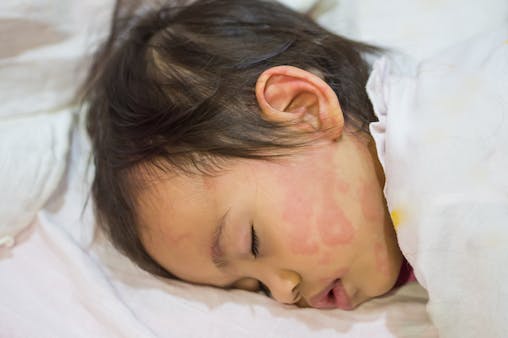
Some people develop hives on the skin when they encounter cold temperatures. This condition, called cold urticaria, is the most common type of hives caused by a physical condition. The hives are produced by a rapid release of histamine brought about by IgE antibodies and eosinophils (the types of antibodies andwhite blood cells often involved in allergic reactions) in response to the cold. Rapid cooling, as from the evaporation when one gets out of a swimming pool, can trigger cold urticaria even on a warm day. For people with cold urticaria, swimming in very cold water is quite dangerous, sometimes even causing death.
Treatment of cold urticaria involves avoiding the cold, when possible, and taking antihistamines. Even though I do not recommend antihistamines for the common cold for most healthy children under age 6, antihistamines can be useful medications for some allergies, including cold urticaria. The antihistamines are best taken before exposure to cold temperatures to block some of the histamine release. When possible, I prefer non-sedating antihistamines for this purpose. The other antihistamines can interfere with learning even if they do not make kids drowsy. For those with severe cold urticaria, like those with other severe allergies, an Epi-Pen or other emergency kit may be life-saving in the case of severe reactions.
Sometimes cold urticaria is a symptom of another problem, such as cryofibrinogenemia, cryoglobulinemia, or syphilis. Even when it is not, you can develop cold urticaria after receiving a blood transfusion from someone who has it. Most people don’t know that allergies can be transmitted in transfusions, but they can!
For some people, cold urticaria is a lifelong condition; for others, it is temporary — only during and after an infection, such as mycoplasma or mononucleosis. Overall, cold urticaria generally lasts about 4 to 5 years, with resolution of symptoms, or at least improvement of symptoms, in 50% of patients within 5 years (Clinical and Experimental Dermatology 32 (3), 241–245.)
Alan Greene MD


Our goal is to improve children's health by inspiring parents to become knowledgable partners who can work with their children's physicians in new and rich ways.