Together, three types of bacteria account for over 90 percent of bacterial meningitis: H. influenza type b, meningococcus, and pneumococcus.
These bacteria are transmitted by person-to-person contact through respiratory secretions. Many people carry these bacteria with no serious consequence. (Pneumococcus, for instance, is the most common cause of ear infections.) A few people get very sick. Pneumococcus causes meningitis in about 3 per 100,000 people. (Textbook of Pediatric Infectious Disease, Saunders 1998)
Sudden onset meningitis features shock, internal bleeding, purple spots, and reduced consciousness at the very outset, with a rapidly progressive course often resulting in death within 24 hours.
More commonly, meningitis begins with several days of upper respiratory symptoms or gastrointestinal symptoms. Most children have high fevers, severe headaches, and poor feeding. They may also have muscle aches, nasal congestion, vomiting, neck stiffness, and seizures.
Children with meningitis become increasingly irritable and/or lethargic. The presence of petechiae (purple spots that indicate internal bleeding) is a sign that the infection may be raging out of control.
Pneumococcal meningitis is a devastating disease. Of all causes of meningitis, it is the most likely to have a negative outcome (Pediatric Infectious Disease Journal, May 1993). The overuse of antibiotics is resulting in increasingly resistant strains of pneumococcus every month.
In 1991, a vaccine against the H. influenzae Type b (HIB) bacteria was incorporated into the routine immunization schedule beginning at 2 months of age. The amount of meningitis plummeted. Arkansas Children's Hospital had about 27 cases of HIB meningitis per year in the 1980's before the vaccine was used. By 1993, the number had dropped to only 1.7 per year (Southern Medical Journal, Jan 1994). During the same period the number of cases dropped by 95 percent in the United States as a whole (Textbook of Pediatric Infectious Diseases, Saunders 1998).
The new pneumococcal vaccine for infants is now FDA approved and recommended by the American Academy of Pediatrics for all children less than 2 years of age. Vaccination of children between 2 and 5 years of age may also be considered on an individual basis. In large clinical studies, the vaccine has been shown to decrease the risk of invasive pneumococcal infection (i.e. meningitis and blood infections) by more than 93%. It has also been shown to decrease the risk of pneumonia and otitis media (ear infections). More information about the vaccine can be found at www.cdc.gov/.
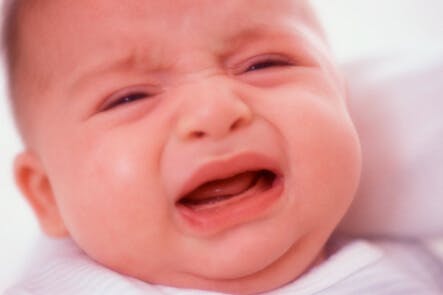
I have a 7-week-old who is very fussy. All he does is cry. He is in pain and I feel so bad for him. He barely sleeps at all. When he is fussy he is also extremely gassy. Any suggestions?
Usually, the peak age for crying is about 6 weeks old, so there is light at the end of the tunnel. After all of the emotions of pregnancy and anticipating a baby, this crying period can be overwhelming for parents.
Different babies respond to different comforting measures. Experimenting and observing what seems to work best for your baby is the best way, through.
Some children are comforted by being held close in a dark room. Some like to be swaddled. Some like to be sung to. Some need to suck on something. Some are calmed by rocking. For many kids, car rides are settling. The motion moves the gas through and gently mesmerizes the child.
Some children are intolerant to cow's milk-based formulas. Most of them will do well on soy, but about 20 percent of them are intolerant to soy as well. Nutramigen or one of the other hydrolysate formulas will often do the trick. Kids may not like them, but they are almost impossible to be intolerant to. Some parents do report relief from gas drops, especially if they are given at every feeding--not just four times a day.
If a baby is not consolable, or if the fussiness increases after kids are 6 to 8 weeks old, it's important to consider other causes, such as reflux. Talk to your pediatrician about possible causes and treatments.
Infections can be avoided both by decreasing the exposure to germs and by boosting your child’s immunity. Click here for 6 powerful ways to decrease germ exposure.
So should we be concerned about a little boy who wants to be called a girl...
I walked without crawling when I was a kid and I think my daughter is on the...
I'm sure you will check with the baby's pediatrician, but you can also check...
Does she have any friends or cousins who are potty trained? My daughter...