
Learning To Share
Question
Dr. Greene, no matter how much I make my children share, they just don't seem to learn. They still get upset whenever someone else plays with their toys. How can I put an end to the endless fighting?
Mary S. - Fairfax, Virginia
Dr. Greene's Answer
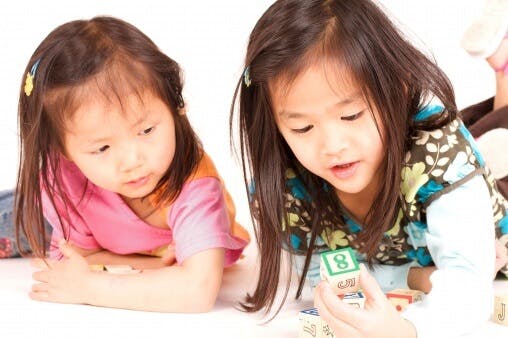
This week I was watching some delightful preschoolers play with a toy pool table together. The owner of the toy was coping reasonably well, and I left the room for a moment. Shouts of, “Mine! Mine!” brought me back to the scene. A furious tug of war had erupted. Each boy was trying to wrest control of the other’s pool cue while not letting go of his own.
“There are two sticks and two boys. Let’s each play with one,” I said. But it didn’t matter which of the identical sticks one of the boys had; he desperately wanted the one being held by his playmate. The other boy was more straightforward; he just wanted both sticks!
Many parenting experts proclaim that children must learn to happily share their toys with siblings and friends. Other popular parenting books declare that children should not be required to share but should instead learn the value of ownership. I will make a few observations before “sharing” my views with you.
Children come with a powerful, built-in “wanter.” Walking down the aisles of a store with a child, one hears pleads of, “I want that one, the red one,” and “I need this one, the big one,” punctuating the air. Children don’t want what they already have nearly as much as they want what is out of reach, unless another child happens to pick up one of the nearly forgotten possessions. Then the “wanter” goes into overdrive. Kids want what others have.
This desire is a tremendously powerful, positive force. It has fueled most of the human and personal achievement and growth in children and adults throughout history. When this desire causes disregard for others, the power turns toward destruction. In this form, it is responsible for most of the oppression, violence, and crime that defaces humanity.
Children also come with a powerful, built-in sense of “mine.” Early on, everything they see is “mine.” For the next several years, learning what belongs to whom and what “belongs” means is an urgent topic on their agendas. Making them share everything sends confusing and troubling messages.
We cannot and should not squelch children’s “wanters” or violate their search to learn about ownership. We can and should help them channel these primordial forces in a positive vein–to use them to prompt creativity, action and stewardship. A growing respect for others is the magic ingredient that imbues these forces with goodness and beauty.
For my children, we have three rules of sharing to help teach respect:
- If you want to use something that belongs to someone else, you must ask first. When the kids go visit someone else, we are teaching them not to run and grab the toys, but to ask (unless, of course, the toy is offered). When others come over, our children can relax knowing that we will gently defend their possessions — “In our home, we ask each other before playing with others’ things.” Sometimes the kids give longstanding permission: “Sure, you can play with that whenever you want–you don’t need to ask.”
- When someone asks to use your things, you can’t simply say, “no.” Nor do you have to say, “yes”. But if you decline to share, respect the other enough to either give a reason or suggest an alternative, such as “Let’s take turns,” “You can play with it, but only inside,” or “That’s my very favorite, but you can play with any of these.”
- Remember the Golden Rule: Do unto others as you would have done unto you. This comes in handy when considering how to answer someone who wants to play with your things. It helps you decide, too, when and what to ask of someone else (I know he just got that new toy, and I like to play with my new toys). This rule is also a wonderful guide for how to handle and care for others’ things when you are using them.
Clearly, these rules are ambitious, sometimes taking a lifetime to really learn. But children are hungry to sort these issues out, and as they mature they find these rules a satisfying solution.
Ultimately, our children learn more from what we do than from what we say. They learn best when what we do and say coincide.
Whatever sharing policy you choose for your children, be sure that it is the way you want your children to share when they are in college or making their way through the adult world. Playing with new toys during the holiday season is one of life’s magical moments, but it also sets the stage for interacting with others for years to come.
Alan Greene MD


Our goal is to improve children's health by inspiring parents to become knowledgable partners who can work with their children's physicians in new and rich ways.