
Dr. Greene’s Organic Rx — Item #7
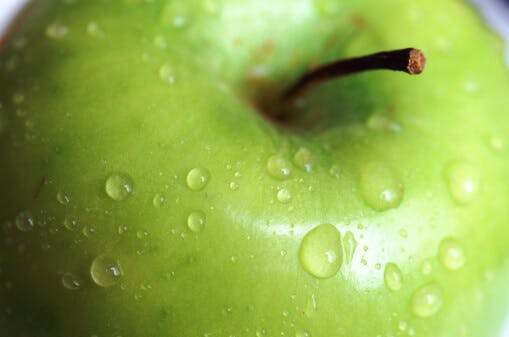
#7 Apples
Consistently named as one of the most pesticide-contaminated fruits and vegetables42, apples make my list because they are more popular than the other fruits and vegetables on the list. Thus, choosing organic apples can make a big difference both in lowering your family’s pesticide exposure and in using our consumer power to change agriculture.
In 2005, apples were the second most commonly eaten fresh fruit (after bananas) and the second most commonly used in fruit juice (after oranges) 43, making them the biggest pesticide concern among fruits. Apples are a major source of our exposure to organophosphate pesticides, which some studies suggest are linked to decreased intelligence and increased attention problems in kids44, as well as changes in hormone levels for some adults45. Thankfully, we’re making progress with apples, with more than 3.33% of U.S. apple orchards already organic46.
When I was in medical school, I was taught that the apple is nature’s “junk fruit”, containing only about 6 mg of vitamin C, some fiber, and not much else of value. Since then we’ve learned that apples are powerhouses of antioxidant activity47. Since I was in medical school, thousands of “new” phytonutrients have been discovered in fruits and vegetables, including in apples. Many of the phytonutrients found in apples, including quercetin, catechin, phloridzin and chlorogenic acid, are strong antioxidants48.
Apples were never at fault, our tests were. Vitamin C wasn’t discovered until 1928. In 2003, a new set of healthful polyphenols were found in apples49. Now we know that each apple has the effect of about 1500 mg of vitamin C – but it gets this from the related compounds in the apple, not the simple version of vitamin C that used to be all we could measure. Organic apples have been found to have higher levels of these polyphenols and other phytonutrients. As an added bonus, in taste tests organic apples taste better than their conventional counterparts50.
Read more from this series
- Dr. Greene’s Organic Rx — What you need to know!
- Dr. Greene’s Organic Rx — Item #1 — Milk
- Dr. Greene’s Organic Rx — Item #2 — Potatoes
- Dr. Greene’s Organic Rx — Item #3 — Peanut Butter
- Dr. Greene’s Organic Rx — Item #4 — Baby Foods
- Dr. Greene’s Organic Rx — Item #5 — Catsup
- Dr. Greene’s Organic Rx — Item #6 — Cotton
- Dr. Greene’s Organic Rx — Item #7 — Apples
- Dr. Greene’s Organic Rx — Item #8 — Beef
- Dr. Greene’s Organic Rx — Item #9 — Soy
- Dr. Greene’s Organic Rx — Item #10 — Corn
- Dr. Greene’s Organic Rx — Bonus Item #11 — Wine
42Environmental Working Group. Test Results: Complete Data Set. Shopper’s Guide to Pesticides in Produce. 4th edition. 2006. http://www.foodnews.org/fulldataset.php accessed Feb 5, 2007
43USDA Economic Research ServiceOrganic Production Data Sets, December 15, 2006.
USDA Economic Research Service. U.S. per capita use of selected, commercially produced, fresh, and processing fruits and tree nuts, 1976-2005. (October 2006).
USDA Economic Research Service. Fruit and Tree Nut Briefing Room, http://www.ers.usda.gov/Briefing/FruitAndTreeNuts/accessed Feb 5, 2007
44Rauh VA, Garfinkel R, Perera FP, Andrews HF, Hoepner L, Barr DB, Whitehead R, Tang D, Whyatt RW. Impact of Prenatal Chlorpyrifos Exposure on Neurodevelopment in the First 3 Years of Life Among Inner-City Children. Pediatrics. 118(6):e1845-e1859. December 2006.
45Meeker, JD, et al. Exposure to Nonpersistent Insecticides and Male Reproductive Hormones. Epidemiology 17(1):61-68. January 2006.
46Certified organic and total U.S. acreage, selected crops and livestock, 1995-2005. USDA. December 15, 2006.
47Eberhardt M, Lee C, Liu RH: Antioxidant activity of fresh apples. Nature, 405:903-904. 2000.
48Jeanelle Boyer and Rui Hai Liu. Apple phytochemicals and their health benefitsNutrition Journal, 3:5 2004.
49Rong Tsao, Raymond Yang, J. Christopher Young, and Honghui Zhu Polyphenolic Profiles in Eight Apple Cultivars Using High-Performance Liquid Chromatography (HPLC) Journal of Agricultural and Food Chemistry. Vol. 51, No. 21:. pp 6347 – 6353. October 8, 2003
50Weibel, F. P, Bickel, R, Leuthold, S., and Alfoldi, T. Are organically grown apples tastier and healthier? A comparative field study using conventional and alternative methods to measure fruit quality. ISHS Acta Horticulutrae 517(Part 7: Quality of Horticultural Products). 2000.
Alan Greene MD


Our goal is to improve children's health by inspiring parents to become knowledgable partners who can work with their children's physicians in new and rich ways.